Oak Ridge National Laboratory, Oak Ridge, TN 37831-6372
(Phenix-muon-97-3; submitted 27 May 1997)
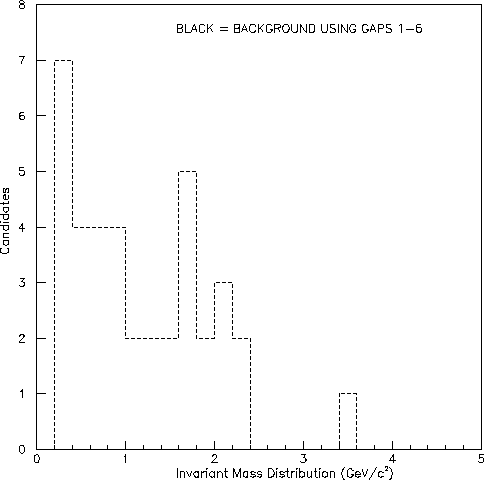
Simulated invariant mass distribution using offline analysis with Gaps 1-6 installed. A sample of 5000 fully simulated PISA Au+Au central events (not containing any vector mesons) was analyzed to find false hypothesis dimuon candidates. Invariant mass combinations of all pairs of charged tracks in each event satisfying "offline cuts" were computed and plotted above. Charged particles such as pions and decay muons contribute to this false hypothesis background. The "offline cuts" (as opposed to a trigger algorithm) are:
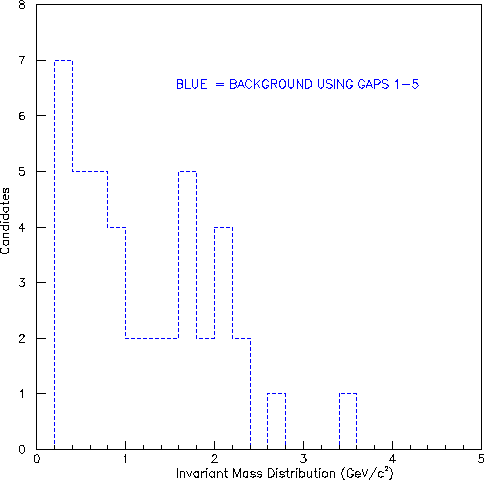
Simulated invariant mass distribution using offline analysis with Gaps 1-5 installed. This plot was produced in exactly the same manner as above using the same events. The only difference is that gap 6 was not used in the offline analysis and any road reaching gap 5 was considered a muon. This was implemented by using 1.0, 1.3, 1.7, 200, 200 GeV/c as the magic numbers.
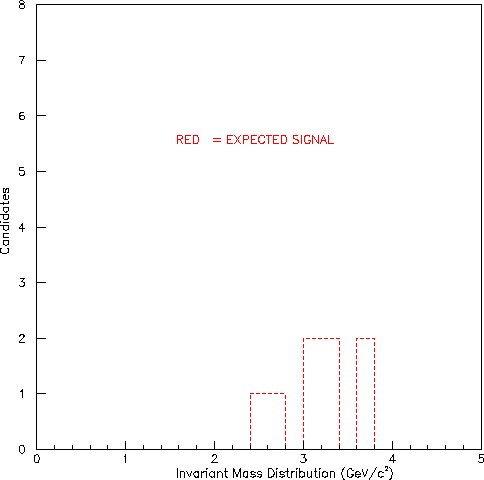
Simulated invariant mass distribution due to expected J/psi signal for 5000 events. Assuming a production probability of 3 x 10⁻³ per central Au+Au event (CDR p. 10-8), we expect 15 J/psi's for this many events. Of those, perhaps 5 would be within the geometrical and momentum acceptance of the north arm. (There are actually 8 events shown here so that I don't have to remake this plot once more background events become available very soon.)
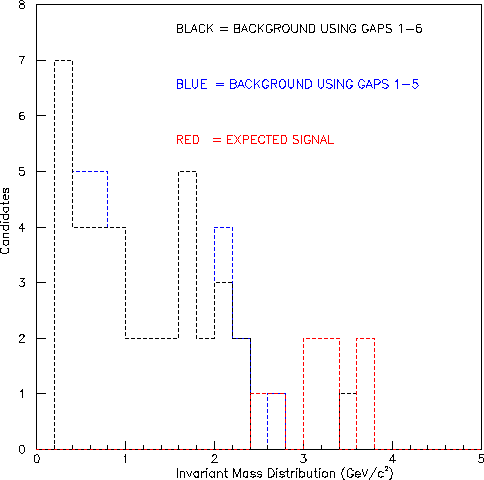
Simulated invariant mass distribution using offline analysis showing the three previous plots sumperimposed.
If the MuTR PISORP code had been run (and it certainly can be run), then the resolution would have been better, the peak would have been narrower, and the important further cut of OPPOSITE SIGN pairs could have been imposed! More background events are being produced. A total of 10,000 would be better. This is the present status of this analysis. These important improvements should be done soon.
In order to have the minimum adverse impact on the physics, one expects that if a gap must be dropped (for financial reasons), then one should not install gap 5 (or possibly 4). However, gap 6 is especially difficult to install and requires special size panels and special length tubes. The construction requires special size tables for the panels in gap 6. This study is not intended to answer "which gap should we drop based on physics originating from the vertex?" (The answer is probably "5.") This study is intended to answer the question "how well can we get by without gap 6 installed?"
By dropping the use of gap 6, the 38 background candidates only increases to 42. Of the four new false hypothesis candidates, only one (in the bin centered at 2.7 GeV/c2) is near the signal peak.