Study of Non-Flammable Gas Mixtures for Muon Tracking Cathode Strip Chambers
D.M. Lee and M.L. Brooks
Introduction
Because of safety issues, it has become highly desirable to operate the muon tracking chambers with a non-flammable gas mixture rather than the baseline gas mixture, CF4:Isobutane, 20:80. Therefore, we have undertaken a study to see if there is a non-flammable gas mixture which will give us the performance which we hoped to achieve with the baseline mixture. Specifically, we would like a gas mixture which:
A detailed review of Lorentz angles provided by different gases was undertaken previously by B. V. Dinesh, and can be found at: http://phnxmu.lanl.gov/Files/muon/notes/phenix-muon-95-22/dinesh.html. The non-flammable gases which were found to provide Lorentz angles which should be adequate for muon tracking were: Ar:CO2:CF4, (50:20:30 or 50:30:20) and CF4:CO2. We have currently looked at the Ar:CO2:CF4 mixture, with and without bubbling the argon through isopropyl alcohol.
Previous Gas Studies
The performance of a prototype muon tracking chamber was previously studied with various gas mixtures. The results of this study can be found at http://phnxmu.lanl.gov/Files/muon/notes/phenix-muon-97-6/muon-97-6.html. In that study, we found that various CF4-isobutane and Ar-isobutane mixtures provided very wide efficiency plateaus and allowed us to achieve our desired chamber resolution, but CF4 mixtures without isobutane did not. However, the reason that we were not able to get good efficiency plateaus for non-flammable gases was because we were using a preamplifier which had a smaller gain than the expected PHENIX preamplifier gain (because no PHENIX preamplifiers were available at that time) and the gases that do not have isobutane in them reach breakdown at a significantly smaller chamber gain than the gases that do have isobutane in them. This caused most of the signals from the non-isobutane gases to fall below the threshold of the ADC even when the chamber was operated very near breakdown voltage. For the current study, we have used prototype PHENIX preamplifiers which, as you will see, provide enough gain to put the chamber signals from non-isobutane gases into the operating range of our ADCs.
Non-Flammable Gas Studies
The same cosmic-ray test stand that was used for the previous gas studies was also used for the current study. Please refer to the paper mentioned in "Previous Gas Studies" for the details of the system.
For this study, we have looked at a mixture of Ar:CO2:CF4 in the ratio 50:30:20. We have not done an exhaustive study of non-flammable gases because our main goal was to determine whether there is a non-flammable gas that we could use in PHENIX operation. As was mentioned in the introduction, a previous review suggested that Ar:CO2:CF4 would be a good gas choice for muon tracking, so we decided to first look at the chamber operating with that mixture.
The breakdown voltage for our prototype Station 2 chamber when it was flushed with Ar:Co2:CF4 was found to be ~1900 Volts. With the PHENIX preamplifier, though, a cathode spectrum at 1900 Volts was found to now be mostly above the range of the ADC so we needed to operate the chamber at a lower voltage.
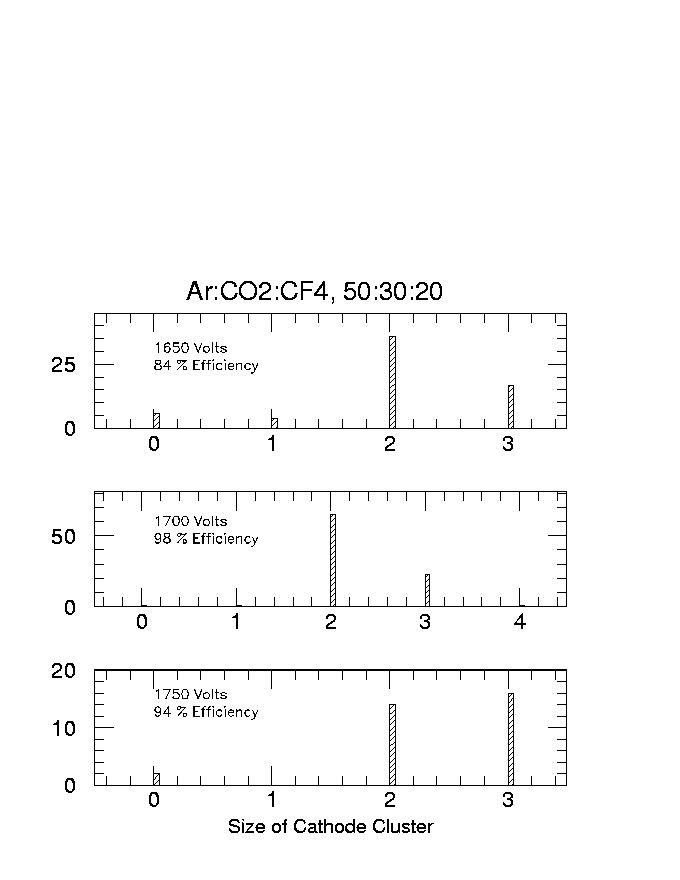
Figure 1 shows the cathode strip cluster size of hits in the prototype chamber for various chamber voltages when a good track was found to be passing through the cosmic-ray test stand and passing through the instrumented area of the CSC. As can be seen, 1750 volts provides CSC signals with at least two strips above threshold 94% of the time. As you move down to 1650 volts, the number of hits with only one strip or no strips above
threshold slowly increases, thus causing the efficiency to decrease. The performance at 1700 and 1750 volts is probably acceptable, but the performance at 1650 volts is marginal.
Figure 1. Cathode cluster width for cosmic-rays which pass through the instrumented region of the prototype chamber, for 3 different voltages and a chamber gas of Ar:CO2:CF4, 50:30:20.
When determining whether a chamber operating voltage will provide adequate CSC performance, you should look at the chamber efficiency as well as the pulse-height distributions. When you are operating at lower chamber voltages, the signal:noise will decrease and eventually cause you to lose chamber resolution, and at higher voltages you need to look at how many tracks produce overflow hits in the ADC (thus causing you to lose some of your resolution) and how many strips are typically above threshold. The number of strips above threshold is mostly important when operating in a high-occupancy
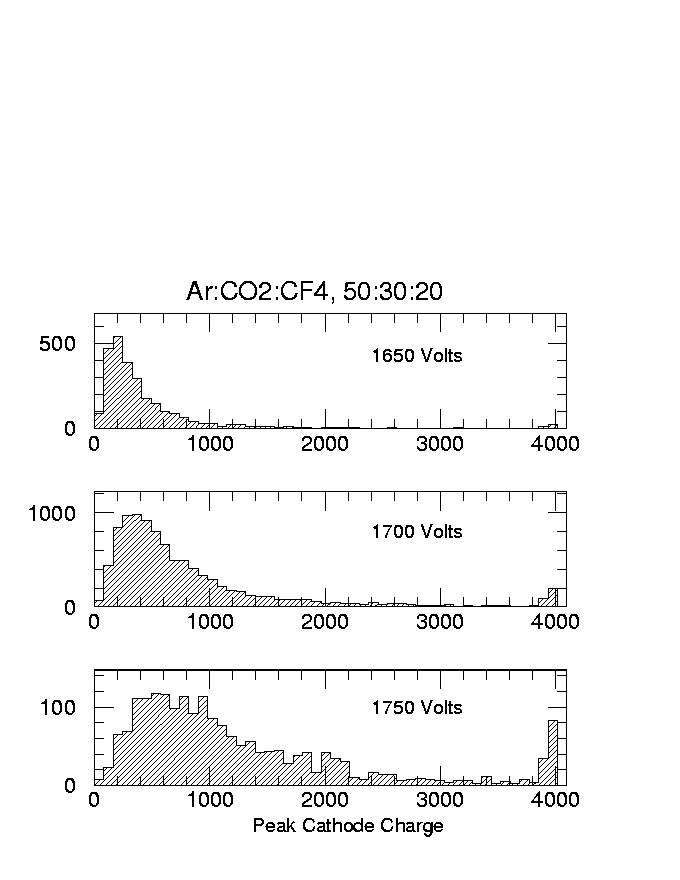
Figure 2. The peak cathode strip charge distribution for three different chamber voltages and a gas mixture of Ar:CO2:CF4, 50:30:20
.environment because more strips above threshold for a given track means that the likelihood that cathode-strip clusters from two tracks will overlap increases (also degrading your resolution). In Figure 1 you can see that a few tracks are starting to produce 4-strip wide clusters at the higher voltages, but the fraction is still quite small. Also, a judicious threshold adjustment might retain efficiency while decreasing the average number of strips in a cluster.
Figure 2 shows the distribution of the charge on the peak cathode strip for the same chamber voltages, 1650-1750 volts. For the noise levels that we expect to achieve with our PHENIX electronics, we need to have our most-probable cathode pulse in approximately channel 400 in the above ADC spectra if we our to achieve our design goal of 100 mm chamber resolution. As can be seen in Figure 2, the operating voltage of 1650 V is also somewhat low if we wish to achieve our desired pulse-height distribution. The operating voltages of 1700 and 1750 Volts provide adequate pulse-height distributions. The 1750 volt distribution has ~4 % of hits producing ADC overflows which is probably still in the acceptable range. Taking these plots together, we can expect to have an operating range of ~100-150 Volts, with a wider range if decreased detector performance is acceptable.
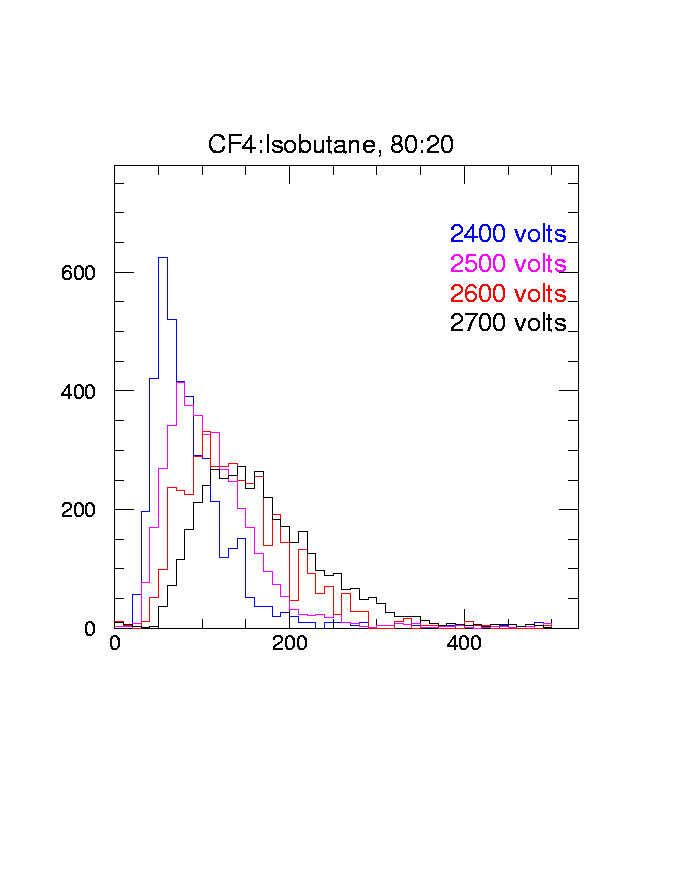 Figure 3. The peak cathode charge distribution from a low-gain preamplifier, a gas mixture of CF4:Isobutane, 20:80, and plateau operating voltages. (Full-scale in the ADC in this plot would be channel 1000.)
One thing to note: The previous studies with the lower-gain preamplifier provided wider plateaus for all gases. I believe that the reason for this is because the plateau was located at higher chamber voltages, which were likely to have been somewhat out of the proportional region and into the saturated region. This means that as the voltage was increased, the charge distribution did not widen as much as it would when operated solely in the proportional region. Since the charge distribution did not widen as much, the chamber could be operated at a higher voltage and still have the charge distribution contained within the ADC range. As an example, you can look at Figure 3 which shows
the same peak cathode distributions, but for CF4:Isobutane, over the plateau region that was found with the low-gain preamplifier and with 2700 Volts being close to break-down voltage. You can see that at the highest voltage, the peak is in approximately channel 150 and the tail of the distribution is almost completely gone by channel 400. In the bottom plot of Figure 2, the peak is in channel 400-450 and the tail extends over most of the ADC range. Any future work should perhaps concentrate on looking for a gas that will provide a narrower charge distribution within our preamplifier/ADC range.
Conclusions
Based on these studies we propose that the nonflammable gas mixture Ar:CO2:CF4 without alchohol become the new baseline mixture for the muon tracking chambers. The operating voltage is lower, the high voltage plateau is adequate and the important issue of flammability is removed.