|
A team led by
Wladek Walukiewicz, working with researchers at Cornell University, and
Ritsumeikan University, Japan, has discovered that, contrary to earlier
reports, the band gaps of the In1-xGaxN ternary alloy system extend over a
very wide energy range (0.7 eV to 3.4 eV) and thus provide a near-perfect
match to the solar energy spectrum. This creates the opportunity to design
and fabricate new multijunction solar cells that will have greatly
improved efficiencies, possibly reaching the theoretically predicted
ultimate efficiencies.
A team led by Wladek
Walukiewicz, working with researchers at Cornell University, and
Ritsumeikan University, Japan, has discovered that, contrary to earlier
reports, the band gaps of the In1-xGaxN ternary alloy system extend over a
very wide energy range (0.7 eV to 3.4 eV) and thus provide a near-perfect
match to the solar energy spectrum. This creates the opportunity to design
and fabricate new multijunction solar cells that will have greatly
improved efficiencies, possibly reaching the theoretically predicted
ultimate efficiencies.
The power conversion efficiency limit for a
solar cell based on a single semiconducting material is 31%. The primary
reason for this limit is that no one material can perfectly match the
broad range of solar radiation, which has usable energy in the photon
range of 0.4 – 4 eV (see figure). Light with energy below the bandgap of
the semiconductor will not be absorbed and thus not be converted. Light
with energy above the bandgap will be absorbed, but the excess energy
above the bandgap will be lost in the form of heat. Decades of research in
developing single-material solar cells has led to cell efficiencies close
to the theoretical limit; the best cell of this type has an efficiency of
25.1%.
It was realized quite early that still higher efficiencies
could be achieved by using stacks of semiconductors with different band
gaps. In this design, the higher gap materials convert higher energy
photons, but do not absorb lower energy photons which then pass through to
the lower |
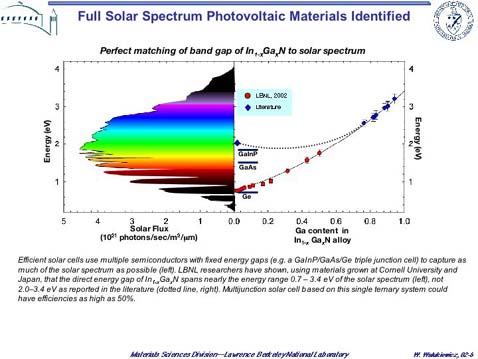
gap materials. Maximum, theoretically predicted
efficiencies increase to 50%, 56%, and 72% for stacks of 2, 3, and 36
junctions with appropriately optimized energy gaps, respectively. Indeed,
tandem solar cells with as many as three semiconductors have been
developed over the last decade and such cells currently have the highest
efficiency achieved; about 30%.
A major challenge in achieving
widespread use of these multijunction solar cells lies in the
identification of materials with the appropriate bandgaps. The 50%
efficient 2 junction cell requires an upper cell bandgap of 1.7 eV and a
lower cell gap of 1.1 eV. The two-layer tandem cells grown to date are
less efficient, using the best available 1.85/1.43 eV band gap combination
that takes advantage of the lattice match of Ga0.5In0.5P and GaAs.
Fabrication of 1.7/1.1 eV band gap cells would be simplified if two
materials in a single ternary alloy system could be used, but it was
believed that there was no suitable system with direct bandgaps in this
optimal range.
Working with crystal growers from Cornell and
Ritsumeikan University, Japan, the LBNL team performed optical tests
(absorption and “photoluminescence”) on a wide range of extremely high
quality InN and InxGa1-xN films grown under carefully controlled
conditions. It was found that the direct band gap of pure InN is 0.7 eV
rather than the previously reported 2.0 eV, which had been measured in
lower quality material. Furthermore, it was shown that alloying the InN
with GaN to form InxGa1-xN can produce materials whose bandgaps can be
continuously varied from 0.7 eV to 3.4 eV. This single semiconductor alloy
system, therefore, has an almost perfect match to the entire solar
spectrum. Not only does this range include the optimal bandgap values (1.1
and 1.7 eV) for a two-layer cell, it will also enable the fabrication of
optimized tandem cells with more layers, for which materials whose band
gaps extend close to the lower and nearly all the way to the upper bounds
of the usable region of the solar spectrum are required. More recent work
has shown that the InxAl1-xN system has direct band gaps spanning an even
wider energy range: from 0.7 – 6.2 eV; thus, this related materials system
may be useful for both solar energy conversion and for other
optoelectronic applications in the near-IR to deep ultraviolet regions of
the spectrum
Although grown on lattice mismatched substrates, all
the InxGa1-xN films show an exceptionally strong and robust
photoluminescence, demonstrating insensitivity of the optoelectronic
properties to structural imperfections. This observation bodes very well
for applications of these materials in environmentally harsh conditions.
To fully implement the InxGa1-xN alloys for photovoltaic applications some
additional hurdles such as control of p-type doping must be overcome,
however the work demonstrates that III-V nitride alloys are promising
candidates for the development of new solar cells with efficiencies as
high as 50%. Furthermore, the discovery extends the range of potential
optoelectronic applications of III-V nitride alloys from the near infrared
to the deep ultraviolet spectral regions.
Wladek Walukiewicz, (510) 486-5329, Materials Sciences Division
(510 486-4755), Berkeley Lab.
J. Wu, W.
Walukiewicz, K. M. Yu, J. W. Ager III, E. E. Haller, H. Lu, W. J. Schaff,
Y. Saito, and Y. Nanishi, “Unusual properties of the fundamental band gap
of InN,” Appl. Phys Lett. 80, 3967-3969
(2002). |