*Oak Ridge National Laboratory, Oak Ridge, TN 37831 USA
**University of Tennessee, Knoxville, TN 37916 USA
(Phenix-muon-97-1; submitted 18 April 1997)
This note summarizes the results of the ORNL gas R&D effort to date.
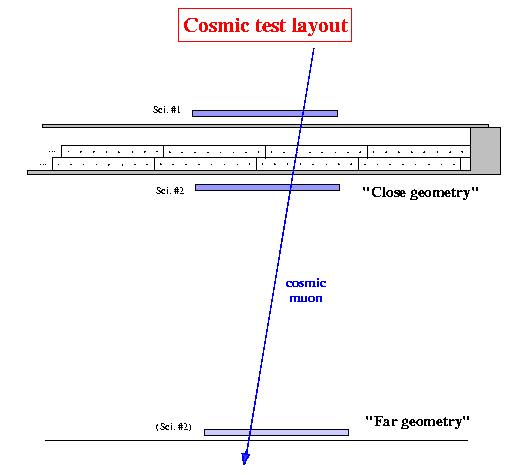
All tests were performed with a cosmic muon stand in the "close" geometry shown in this figure.
Figure 1. Cosmic ray test stand used in these studies.
The "far" geometry is more realistic since we expect muons to be nearly normally incident, but we believe the "close" geometry to be good enough and the much higher count rates (due to solid angle) make it much more convenient. The amplitudes are somewhat lower in the "far" geometry as shown in the following figure.
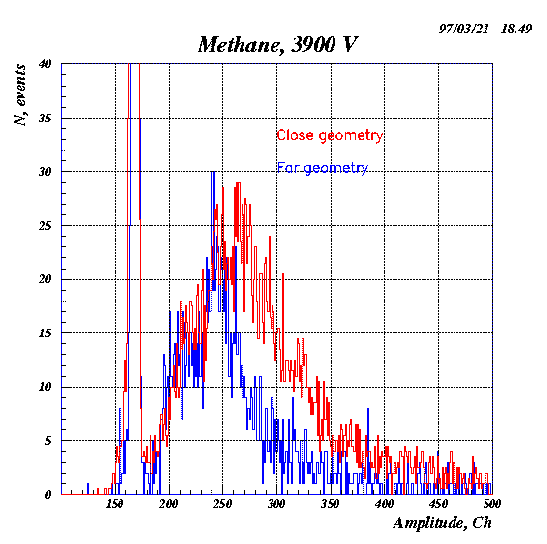
Figure 2. Signal amplitudes for "close" and "far" geometries.
This note does not summarize the electronics R&D effort since it is not yet mature. But, some facts are known which are important to understanding the direction of the gas studies.
Many of the gas tests were performed with a readout scheme having coaxial cables and no in-panel preamplification. This is contrary to the baseline advocated at the Costa Mesa meeting we used. The reason for this is that we discovered that the primary source of noise (at least in our lab) was the tube itself, due to the large tube capacitance (roughly one nF for a ganged pair of tubes). Therefore preamplification did not help much. We still advocate an in-panel preamplifier in order to guard against pickup on the long (> 15 m) signal cable runs before the FEMs.
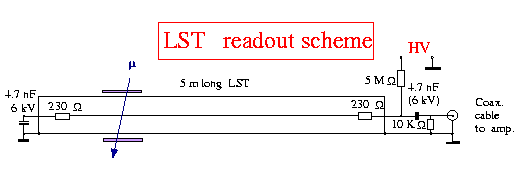
Figure 3. Iarocci tube readout scheme used for these tests.
We discovered that a constant fraction discriminator buys us about 15 nsec in the width of the drift time distribution. This can be worth several percentage points in per-gap trigger efficiency. This benefit of the CFD is due to the fact that the shaped signals had a very slow rise time (roughly 15 nsec), and our discriminator level was not very far below the smallest signals. Thus the smallest signals need almost their full rise time to cross the threshold, increasing the width of the distribution by that value. The CFD eliminates this signal "walk" by always triggering at a particluar point on the signal (for example, the peak). So far we have compared performance with and without the CFD only for Ar/isoButane and with a particular shaping filter.
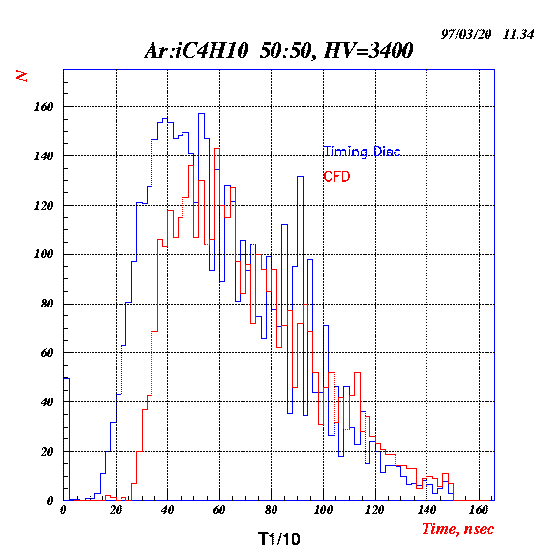
.Figure 4. Drift time distribution with leading edge and constant fraction discriminators.
A prioritized criteria list for gas selection follows:
Many of the gases failed because the efficiency plateau was very short. This is because of the large inherent tube noise (see above) which required us to go to relatively high voltage to get the signals above the noise. We had to get near breakdown for many gases before we achieved any efficiency.
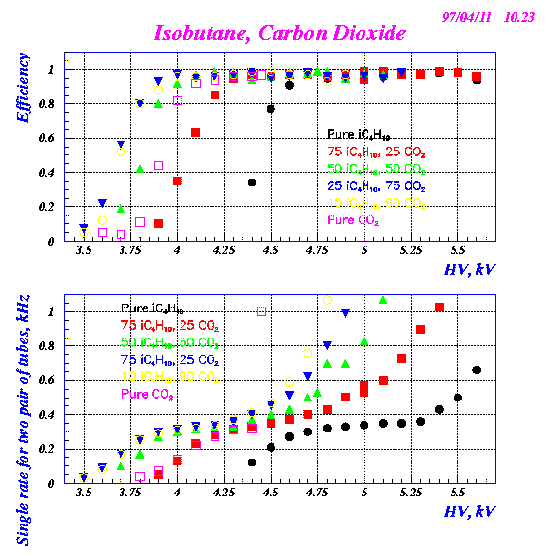
Figure 5. Efficiency and single's plateaus as functions of high voltage for different ratios of isoButane and CO2.
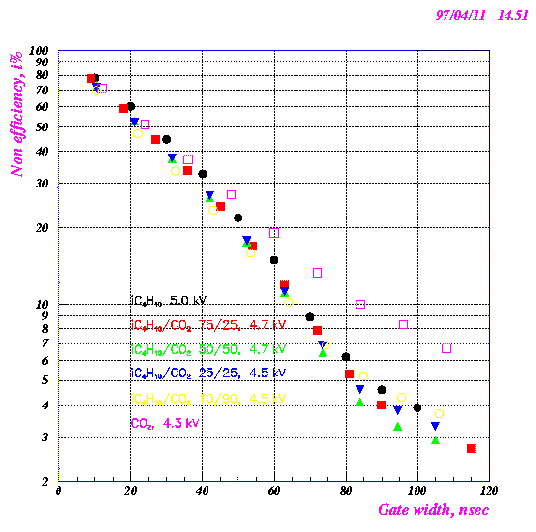
Figure 6. Inefficiency as a function of LVL1 trigger gate width for different ratios of isoButane and CO2.
Note that the timing plots were made with the signals going through a constant-fraction discriminator. If the CFD buys us 15 nsec for this gas mixture, shaping parameters, etc. then it buys roughly five percent in efficiency. We are about to start optimizing the CFD and shaping parameters for this gas mixture.
The ratio of the two gases in our mixture does not seem to be critical for performance. Although somewhere between 90% CO2 and pure CO2 the behavior must deteriorate since pure CO2 has a negligible efficiency plateau and is relatively slow. So far, the only difference we see between different ratios is the gas gain. The figure below shows the most probable value of the signal amplitude for different gas ratios. We may want to optimize the gas gain (a 50/50 mixture) or minimize safety hazard and expense (10/90 isoButane/CO2?). This decision has not been made.
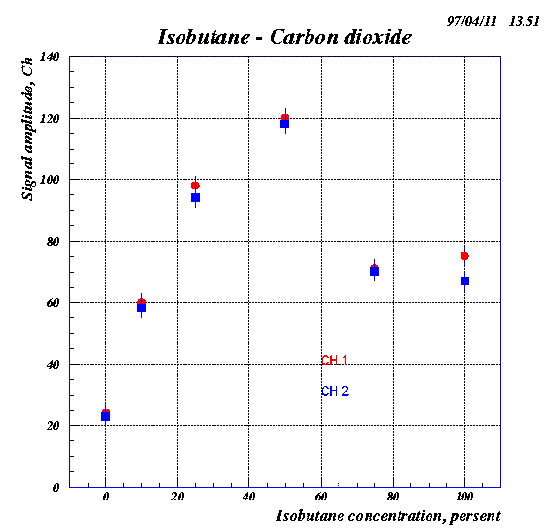 Figure 7. Most probable signal amplitude
for different ratios of isoButane and CO2.
Figure 7. Most probable signal amplitude
for different ratios of isoButane and CO2.
We have found a gas mixture (isoButane/CO2) which satisfies all of our requirements. There is a very wide range of acceptable ratios, and ratio of the two gases has not been decided. But, we believe the mixture will contain between 25 and 60% isoButane. Our plan is to optimize electronics with a 25/75 isoButane/CO2 mixture and return to the question of the exact ratio later.