Specification for MuID Variable Delay
Vince Cianciolo, ORNL
Since MuID is a LVL1 trigger detector the struck-tube bit pattern for
a given event must be valid at the corresponding beam clock
edge. There are three possibilities for the timing distribution of the
hits relative to the beam clock. These are illustrated in figure 1
below.
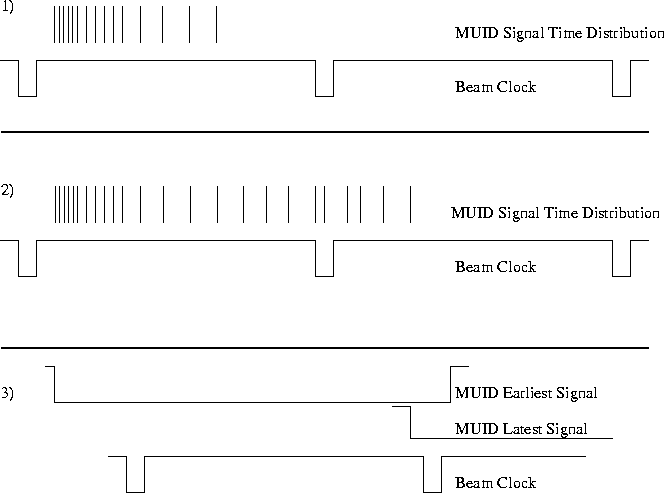
Figure 1. This figure illustrates the three different
possibilities for the timing distribution of MUID hits relative to the
beam clock. The trigger input at each beam clock will be the bit
pattern valid at that beam clock. See text for description.
Referring to figure 1:
- Case #1: All hits belonging to one interaction arrive within a
time window shorter than the beam cycle. This is the ideal case - the
hits edge-encode a series of flip-flops that are interrogated at the
following beam clock edge.
- Case #2: The hit time distribution is wider than the beam cycle,
but we go with the same readout scheme as in case #1. Here the problem
is inefficiency. Any hits which aren't valid until after the flip-flop
interrogation will be lost. In the case of the MUID, every few
nanoseconds is about a 1% drop in efficiency. There is also the
problem that the late hits will show up in the next beam cycle. This
level of noise should not be an issue.
- Case #3: The hit time distribution is wider than the beam cycle,
but the readout scheme is different. In this case we make the signals
wide enough that at some point all signals from an event will be
valid. We then time things so that the beam-clock edge overlaps this
time. The problem here (as can be seen in the figure) is that
early signals will also be valid on the previous beam
tick. Since the time distribution is weighted towards early times
(as I have attempted to depict) it is likely that a valid road through
the MUID will trigger on two beam ticks. The earlier of these beam
ticks is not the correct one, and so the data recorded when the
trigger fires will be data from the previous crossing
(junk!). Furthermore, that earlier trigger will block the correct the
correct trigger from being accepted. Note that we cannot simply time
things so that the earlier beam tick is the correct one - this would
have the effect that the late hits are lost, as in case #2.
For these reasons, we feel that it is necessary to reduce the width of
the hit time distribution below that of the beam clock. There are two
terms which contribute to the time-difference spread for a given
tube:
- The largest affect is the drift time of electrons ionized by a passing
particle to the anode wires in the Iarocci tubes. This is an inherent
spread, virtually identical for each tube. We have taken two steps to
minimize this spread. A single readout channel consists of two
half-cell staggered Iarocci tubes. This ensures that a particle
passing through at normal incidence will pass close to the wire in one
of the two tubes. Also, we completed a gas R&D program to
identify a gas which was fast, but which possessed an acceptable
efficiency plateau and was relatively inexpensive and safe. A gas
mixture was found, Isobutane/Carbon Dioxide in roughly equal
proportions. Almost all hits are recorded within a spread of 80-90
nsec.
- This spread is convoluted with the translation time of the pulse
along the anode wire and with the flight time to a particular tube
(for the moment we are only considering the panels in a single
gap). Because the electronics end of the tubes is furthest from the
interaction point, these two effects largely cancel, although not for
the horizontal tubes of the central (small) panels. Both ends of these
tubes are equally far from the interaction point. So in this worst
case the combination of these effects will be 15 nsec.
Note that the resulting natural time spread of hits is almost the
width of the beam clock gate. (Although the beam cycle is 106 nsec, we
probably only get 96 nsec or so - the DMU requires signals be true for
at least 5 nsec and I'm guessing that there is a similar dead spot at
the beginning of the cycle for flip-flops to clear.) This forces the
requirement for a rather precise match of the time between the
earliest possible outputs of all tubes relative to the their DMU
clock. We have proposed to satisfy this requirement by building a
variable delay unit into the MuID ASIC with a maximum length of 60
nanoseconds with 15 adjustable (2-4) nanosecond steps. This delay is
used to cancel out terms which don't change this natural spread for a
given tube, but which do move the the earliest possible outputs of
different tubes differently. The fineness of the steps is dictated by
the fact that a T0 shift of 3 nanoseconds is roughly equivalent one
percent efficiency. Based on a warning we received from the pCDR
committee regarding skew in our long (15m) readout cables, this delay
has been specified as having a per-channel adjustment.
The maximum length of the delay is given by adding a bit of a safety
margin to the worst case scenario arising from the following five
contributing terms:
- First is different internal cable lengths and the difference in the
average flight times to different tubes in a panel. Again, because the
electronics are away from the interaction point, these effects largely
cancel. There should be less than a 5 nsec shift between different
tubes in a panel.
- Second there is the difference in flight time to panels in different
gaps. This is less than 8 nsec. This could in principle be canceled
with careful cable-length tuning.
- Third, there is the possibility of significantly different
external cable lengths. Since the FEM crates are proposed to lie on
the west wall, there is the possibility that the cables for the east
panels would be 13 meters longer than the cables for the west
panels. This would result in roughly 65 nsec of shift. We propose that
all cable lengths be equalized, eliminating this contribution.
- Fourth, there is the possibility that the signal cable delay time
is significantly different channel to channel. We have been warned
that this could be a significant effect (15 nsec) given the length of
our signal cables.
- Finally, there is skew inside the FEM itself from distribution of the
beam clock to different readout cards. This contributes 7 nsec
maximum, assuming we stick with ECL drivers and that we don't use a
fancy serpentine to equalize trace lengths on the backplane.