|
![[Up]](../common_gifs/arrow.marble.up.gif)
|
![[Next]](../common_gifs/arrow.marble.right.gif)
Previous slide
| Up to slide index
| Next slide
| |
|
|
|
| Previous slide
| Up to slide index
| Next slide
| |
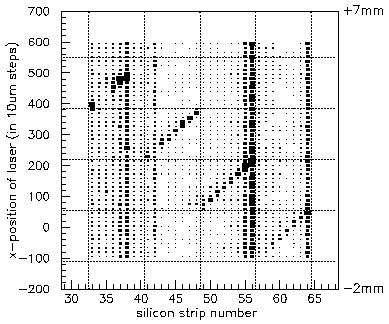
Back at Los Alamos, we put the same detectors and electronics in a laser
station. Here, we can aim a 40um diameter pulse of IR laser light into the
silicon. After synchronizing the laser pulse, movement and the LVL-1 trigger,
we obtained the scan shown below for detector #2, channels 33-64. The laser is
scanned across all 32 active channels, in 10 um steps; at each step, 30 pulses
are triggered. An entry is made in the plot for each channel that exceeds a
fixed threshold (250 channels)
One can see that strip numbering (the order in which signals appear in the
event that the Heap Manager FPGA ships out of the FEE), is flipped in groups
of 8.
Some channels (37,38,55,56,64)are noisy, and some are dead (34,35,39,40).
Also, the gain in the 4th chip (57-64) is generally low.