SCHEMATIC LAYOUT OF THE MVD ANCILLARY SYSTEMS
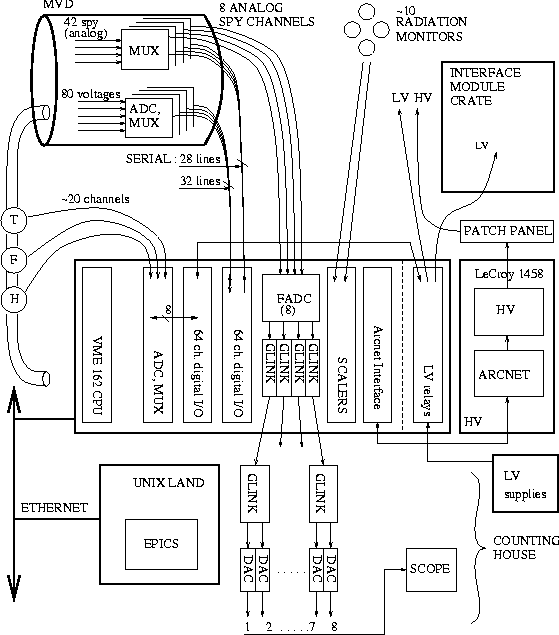
Logically, the MVD can be divided into east and west halves, and each half is read out to its north and south ends. Thus here are 4 motherboards with connections to the outside world.
In each quarter, there are 42 MCM temperature sensors, and 35 LDO voltages to be read out. In addition, the temperature at 3 locations on the motherboard is monitored, for a total of 80 voltages per quarter. There is not enough space to feed 80 signals out, so they are converted by scanning ADC's on the motherboard, multiplexed together and fed out over a serial link, one per motherboard. The serial lines go to the MVD 'Black Box', which is a 6U VME crate, with a controller running VxWorks, so that it can be part of the EPICS system, as well as allow easy access to, and control of the modules in the crate.
The serial lines are handled by a digital I/O module, which is controlled by a C-program running in the crate's CPU, (much as we currently talk to the Xilinxes in the clean tent). Details on a separate page.The data then end up in memory, and we will try to find out how to get them from there into EPICS.
Each MCM also has 2 analog spy lines, one connected to the preamp output and one to the AMU output, for a total of 42x2 per quarter. These signals are multiplexed on the motherboard, so that only 2 analog lines per quarter are fed out. In the Black Box these will be digitized by 6-bit FADC's, running at 40 MHz. We can use one Glink per 2 FADC's (actually since a Glink is 20 bits wide we could have 3 FADC's per link) to get the data to the counting house, where 8 DAC's turn the signals back into analog, so we can look at them with a scope. A separate page shows this scheme in detail.
There are about 20 more signals generated by temperature, flow and humidity probes located on or near the cooling units. We will fabricate a board duplicating the ADC, MUX circuitry of the mother boards.
Temperature sensor details: The temperature sensors on board the MVD are
thermistors from Analog Devices Inc. We will use the AD590, together with the
TMP12 and the ADT14 chips. The thermistor takes 5V in, and produce a current
proportional to the temperature. The current is sent across a 2K resistor, and
the voltage across this resistor is what is read out. For more details
look here.
The external temperature, flow, humidity sensors come from Omega.
Details here.
There will be (approximately) 10 pin-diode radiation monitors, 4 on each pole face and 2 near the beam pipe at z=0. These will be in place before the MVD is installed to characterize the radiation environment. The central ones will be removed when the MVD arrives, but the 8 on the pole faces will remain in place. Each unit has its own amp and discriminator, and the signals go to scalers in the Black Box, which makes the counts available to EPICS.
The Black Box will also contain the interface (CC-121) to the standard Phenix HV system (LeCroy 1458). A patch panel is needed to convert the HV supply cables/connectors to the cables/connectors which go up to the MVD. This patch panel may end up as a passive module inthe Black Box.
In addition the box provides low voltage to the crate which houses the MVD interface boards (DCM, timing, control, trigger inerface modules), and power to the external sensors. These low-voltage are likely to be 8 double-wide 6U modules. There is no room in the crate for all this, so the LV modules will be housed in a physically separate crate, but logically connected by a VME extender connection. This is indicated by the dotted line.